OpenAI's Real Motive #pm #ai #workautomation
OpenAI's Real Motive #pm #ai #workautomation
OpenAI's real motive, Google's fierce counterattack (This Week's AI War Report) Your App Is Coming to ChatGPT (This Week's Must-Read AI News) AI Weekly: OpenAI's App Store Relaunch, Google's Vibe-Coding App, and a $180 Million Automation Tool The AI industry has been turned on its head again in just one week.
OpenAI has reopened the ChatGPT App Store, and Google has struck back with an AI vibe-coding app. Meanwhile, a little-known automation tool secured $180 million in funding.
Feeling lost in the whirlwind of news? Don't worry. A PM with 6 years of experience at an AI startup will perfectly dissect the true meaning behind all these events and the opportunities we need to seize.
#AINews #OpenAI #Google #ITtrends #Startup #ChatGPT #VibeCoding #WorkAutomation
In the AI industry, the world changes not in a week, but in the blink of an eye.
This week was another whirlwind of crazy news.
OpenAI launched something new again, Google struck back with a new app, and a little-known automation tool secured a whopping $180 million in funding.
If you just skim these news items, they might seem like simple IT gossip. But if you read between the lines and see the shifting landscape, you'll find incredible opportunities.
Today, through the eyes of a PM with six years at an AI startup, I will perfectly dissect the essence of the three most important events of this week.
Hello, this is Callit AI, bringing you raw productivity for the AI native.
Event #1: OpenAI's Relaunch of ChatGPT Apps. What's Their Real Motive?
First off, OpenAI has made another move. They've launched a feature called ChatGPT Apps.
If you're thinking, "Huh? Isn't that the thing that came out as GPTs and failed?" you're half right and half wrong.
The old GPTs were more about sharing chatbots we created with others, almost like a marketplace for well-crafted prompts. But these new Apps are on a whole different level.
Now, right within the ChatGPT chat window, we can install and run services from external companies as if they were apps.
For example, while talking to ChatGPT, you could say, "Create three design drafts in Canva based on what we just discussed," and ChatGPT would instantly call the Canva app to create the designs.
From a PM's perspective, what does this mean?
This is OpenAI blatantly revealing its ambition to become more than just a smart chatbot. They want to be a massive platform where all services converge, just like Apple's App Store or Google's Play Store.
They are essentially saying, "Users, stop switching between different apps. Just stay inside our ChatGPT and get everything done with a single sentence."
It's a terrifying strategy to completely lock users into their ecosystem.
So, what's the opportunity for solo entrepreneurs or small teams like us?
A massive one. Now, without having to spend millions on building a separate app, a path has opened for us to turn our ideas into apps—and even monetize them—on ChatGPT, the platform with the highest traffic in the world. Whoever creates the most useful mini-app inside ChatGPT could become the winner in this new market.
Event #2: Google's Counterattack, the Launch of AI Vibe-Coding App Opal
With OpenAI moving to expand its ecosystem like this, it was only natural that Google wouldn't just stand by.
Google launched an AI vibe-coding app called Opal.
Opal is still in early access, so what the tool does exactly is still shrouded in mystery. However, based on the information released so far, it seems to be a service that generates functional code from text ideas, much like Lovable or Tempo, which we often cover on our channel.
From a PM's perspective, this move by Google is very important.
Google isn't trying to dominate the market with a single powerful model like OpenAI. They're using a strategy of pulling both developers and users into their ecosystem through numerous tools like Android, Google Workspace, and now, Opal.
It's a clear signal that the AI market, much like the mobile war between Apple and Google, is evolving beyond a battle of model performance into a battle of ecosystems.
Event #3: Automation Tool n8n Secures $180 Million in Funding
Finally, and this might be the most important news of all today.
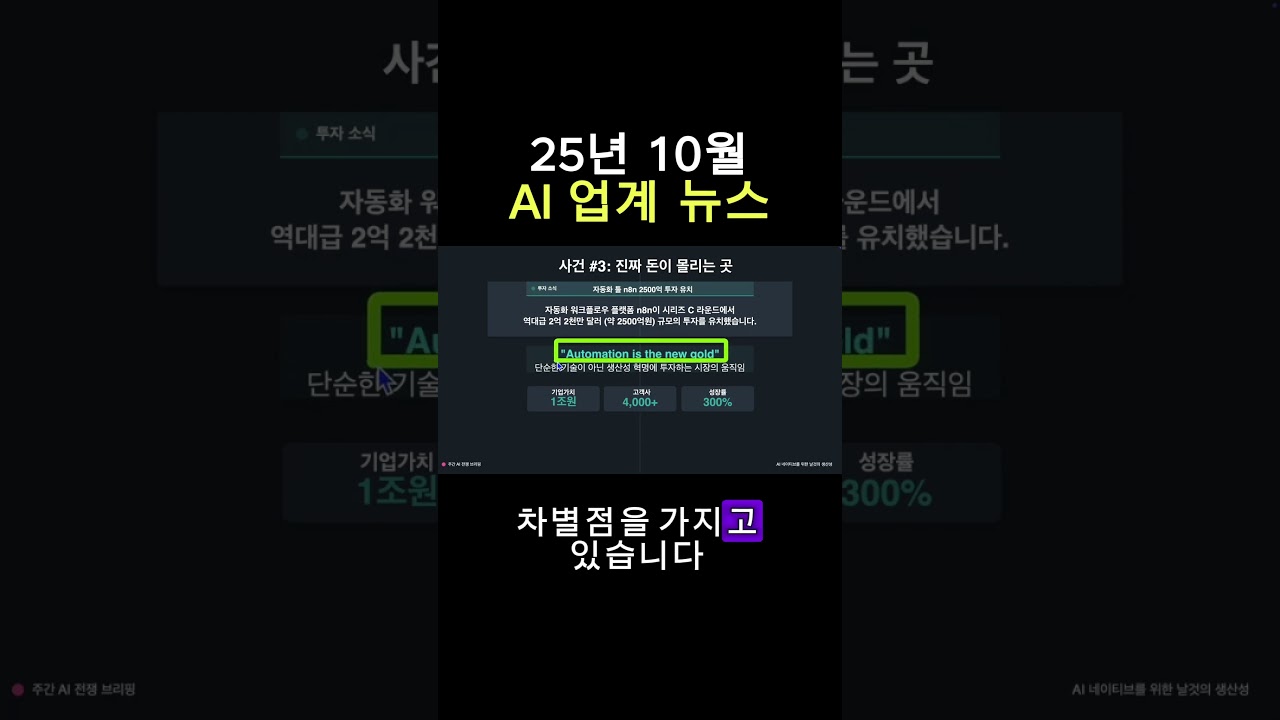
A company with a somewhat unfamiliar name, n8n, has raised a staggering $180 million—about 250 billion won—in its Series C funding round.
n8n is a tool that, like Zapier, connects various apps to automate workflows. But why is so much money pouring into a market where a giant like Zapier already exists?
n8n is open-source and differentiates itself by enabling much more complex and sophisticated, developer-level automation than Zapier.
From a PM's perspective, the message this event sends us is clear.
The real gold mine in the age of AI isn't the fancy AI models themselves, but the field of automation—connecting and weaving these models together to solve real-world business problems.
What's the point if an AI can generate a hundred brilliant ideas? If you can't connect those ideas to actual work processes to create results—like increasing revenue and cutting costs—it's all useless.
VCs saw the value in making that connection, and that's why they bet $180 million.
Conclusion: The One Opportunity You Need to Seize This Week Alright, let's wrap this up.
OpenAI is trying to become a platform, Google is countering with an ecosystem, and the real money is flocking to automation.
What is the single opportunity that all these trends are pointing to?
It's building small services that use AI to automate solutions for people's specific problems.
And now, thanks to OpenAI's ChatGPT Apps, the perfect stage has been set to build and distribute those services.
In the midst of this massive paradigm shift, what opportunity will you seize?
If you found today's content helpful, don't forget to subscribe and like. I'll be back next week with even sharper insights. Thank you.